

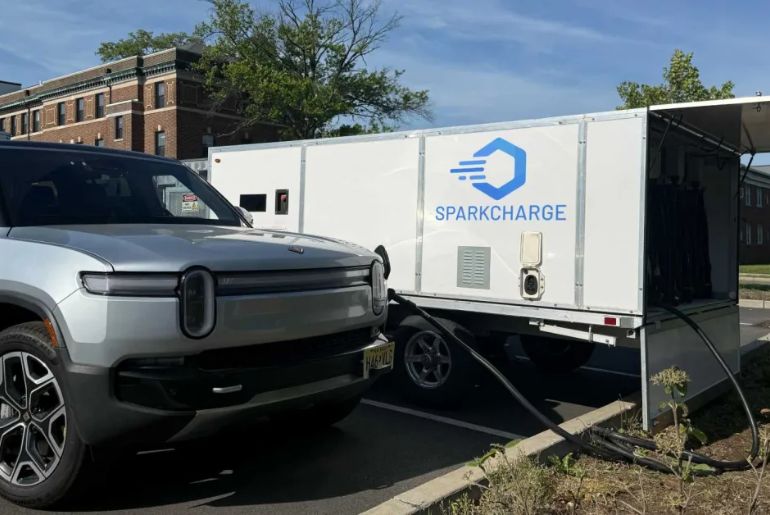
In a major breakthrough for electric vehicle (EV) infrastructure and shared mobility, SparkCharge, in partnership with the Massachusetts Clean Energy Center (MassCEC) and Zipcar, has launched the first-ever off-grid mobile DC fast charging hub in East Boston, Massachusetts. The innovative project aims to accelerate EV adoption without relying on traditional utility grid upgrades, especially in densely populated urban areas.
The charging hub has been installed at Zipcar’s East Boston vehicle maintenance facility and is designed to support the rapid electrification of shared mobility fleets.
Mobile, Off-Grid Fast Charging Without Utility Dependence
At the heart of the project is SparkCharge’s battery-powered mobile charging trailer, which delivers up to 320 kW of DC fast-charging capacity. Unlike conventional charging stations that require costly and time-consuming grid upgrades, SparkCharge’s solution operates completely off-grid, drawing power from its onboard battery storage.
Once depleted, the mobile charging unit is recharged using existing site power, making it an extremely flexible and scalable solution for locations where permanent grid connections are limited or unavailable.
Boost for Zipcar’s Growing Electric Fleet
The off-grid fast charging hub will primarily serve Zipcar’s expanding EV fleet, enabling faster vehicle turnaround, increased availability, and improved reliability for customers across Greater Boston. With faster recharge times, Zipcar can deploy more electric vehicles on the road while reducing downtime between trips.
This deployment also supports Zipcar’s long-term sustainability goals of reducing carbon emissions while maintaining high service efficiency for shared mobility users.
Advancing Equitable Access in Environmental Justice Communities
East Boston is officially classified as an Environmental Justice (EJ) community, where access to EV infrastructure has traditionally lagged behind wealthier urban areas. By deploying off-grid fast charging in such a location, SparkCharge, MassCEC, and Zipcar aim to promote equitable access to clean transportation.
The project directly addresses infrastructure gaps by delivering fast, reliable EV charging to communities that have previously been underserved.
Supported Through MassCEC’s InnovateMass Programme
The project has been supported by funding from MassCEC’s InnovateMass programme, which focuses on advancing clean energy technologies and accelerating commercial adoption across Massachusetts. The initiative plays a crucial role in piloting next-generation EV charging solutions that can be rapidly replicated statewide and beyond.
A Scalable Blueprint for the Future of EV Infrastructure
Industry experts view this deployment as a blueprint for the future of EV charging infrastructure, particularly in urban centres, transit hubs, and shared mobility depots. Key advantages of off-grid mobile charging include:
-
Rapid deployment without utility approvals
-
Lower upfront infrastructure costs
-
Grid-independent operation
-
High-power DC fast charging
-
Scalable expansion across multiple locations
This flexible approach could reshape how cities deploy EV infrastructure in high-demand, space-constrained environments.
Strengthening the Shared Mobility–EV Ecosystem
The collaboration strengthens the intersection of shared mobility, energy storage, and clean transportation. By combining SparkCharge’s mobile energy technology with Zipcar’s shared EV network and MassCEC’s clean energy backing, the project pushes the boundaries of how electric vehicles are supported in real-world fleet operations.
What This Means for the EV Market
The successful deployment of this off-grid fast charging hub is expected to:
-
Accelerate EV adoption in urban and fleet-based mobility
-
Reduce dependence on grid expansion for infrastructure rollout
-
Improve access to charging in underserved communities
-
Support emission-free shared transportation models
-
Enable faster, more flexible EV infrastructure development nationwide
As cities continue their shift toward net-zero transportation goals, SparkCharge’s mobile off-grid charging solution could play a pivotal role in overcoming one of the biggest barriers to EV adoption—charging accessibility.
 Click Here to get the latest EV news and exclusive updates from EV Mechanica on WhatsApp!