

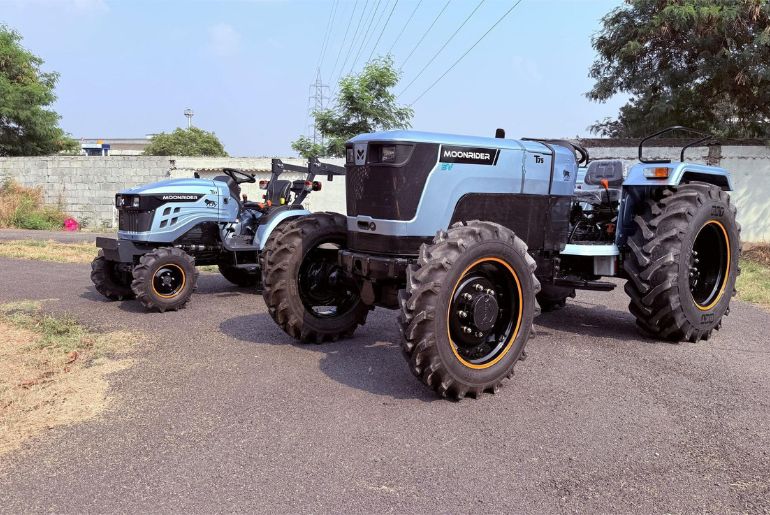
Bengaluru-based EV startup Moonrider has successfully raised $6 million in a Series A funding round to accelerate the commercial rollout of its road-ready electric tractors in India. The round was led by Pi Ventures, with participation from Singularity AMC and existing investors including AdvantEdge Founders and Micelio Fund. The fresh capital will enable Moonrider to transition from pilot deployments to large-scale production, strengthening its position in India’s growing sustainable agriculture market.
Revolutionizing Indian Agriculture with Electric Tractors
Moonrider is developing fully homologated electric tractors designed for varied farming needs. These EV tractors promise up to an 80% reduction in operational costs compared to diesel tractors while maintaining comparable performance levels. By integrating drivetrain, battery, and electronic systems in-house, Moonrider claims to achieve price parity with conventional diesel tractors, potentially making electric farming equipment more accessible to Indian farmers.
Funding to Drive Production and Expansion
The $6 million Series A funding will be utilized to:
-
Ramp up production capacity for multiple tractor models (27 HP, 50 HP, 75 HP)
-
Enhance battery technology and drivetrain efficiency
-
Expand pilot programs into full-scale commercial operations across India
This investment underlines growing investor confidence in the electrification of agricultural machinery, especially as rising fuel costs and environmental concerns drive demand for sustainable solutions.
Impact on Sustainability and Farming Economics
The adoption of electric tractors could significantly reduce diesel dependency and carbon emissions while lowering long-term operational costs for farmers. Moonrider’s EV tractors also provide advanced features such as IoT-enabled monitoring and telematics, helping farmers optimize field operations efficiently.
Positioning for the Future of Electric Agriculture
With this funding, Moonrider is poised to scale rapidly, making electric tractors a viable alternative to traditional diesel-powered machinery in India. The move is expected to catalyze the transition to sustainable, cost-effective farming, marking a significant milestone in India’s journey toward electrified agricultural mechanization.
 Click Here to get the latest EV news and exclusive updates from EV Mechanica on WhatsApp!