

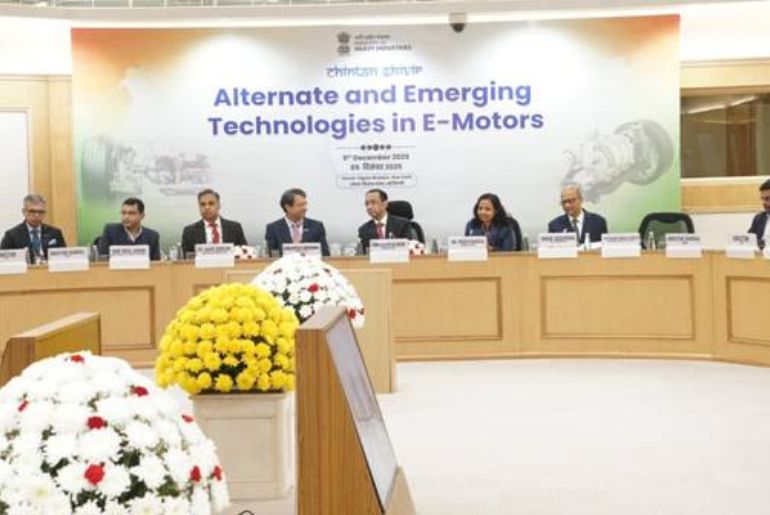
The Ministry of Heavy Industries (MHI), Government of India, organised the Chintan Shivir on Alternate & Emerging Technologies in E-Motors at Vigyan Bhawan, New Delhi. The event brought together policymakers, industry leaders, researchers, and technology innovators to discuss advanced e-motor solutions that will accelerate India’s transition to sustainable and clean mobility.
The Shivir focused on fostering indigenous electric motor technologies, reducing dependence on imported rare-earth materials, and enhancing domestic manufacturing capabilities in the EV sector.
Focus on Alternative and Rare-Earth-Independent Motor Technologies
A key theme of the Shivir was the exploration of rare-earth-free and efficient motor technologies. Discussions centered on:
-
Induction Motors (IM)
-
Switched Reluctance Motors (SRM)
-
Wound-Field Synchronous Motors (WFSM)
-
Permanent-Magnet-Assisted Synchronous Reluctance Motors (PMA-SRM)
-
Motors using ferrite or non-rare-earth magnets
These technologies are being considered to diversify India’s e-motor ecosystem, reduce reliance on imported rare-earth elements, and promote Atmanirbhar Bharat in the EV sector.
Segment-Wise Roadmap Across Vehicle Categories
The Shivir also outlined a segment-wise roadmap for implementing alternative e-motor technologies across:
-
Two-wheelers and three-wheelers
-
Passenger cars
-
Buses and commercial vehicles
The roadmap provides short-, medium-, and long-term technology adoption strategies based on performance, cost-efficiency, and technical feasibility. This structured approach ensures that India’s clean mobility transition is inclusive and technically viable across all vehicle categories.
Emphasis on Supply-Chain Resilience and Indigenous Manufacturing
Global supply constraints, particularly on rare-earth elements, have posed challenges to EV manufacturing. The Chintan Shivir emphasized:
-
Building a resilient domestic supply chain for e-motors
-
Promoting indigenous manufacturing of critical components
-
Encouraging research, development, and innovation in EV motor technologies
Officials highlighted that strengthening local manufacturing capabilities is critical for reducing import dependence and ensuring sustainable EV growth in India.
Strategic Significance for India’s Clean Mobility Goals
The Chintan Shivir represents a pivotal step in India’s push for clean and sustainable mobility. By promoting alternative and rare-earth-independent motor technologies, the initiative aims to:
-
Accelerate the adoption of cost-effective and efficient EVs
-
Enhance self-reliance in critical EV components
-
Mitigate risks from global commodity supply shocks
-
Boost innovation and R&D in electric mobility technologies
The event also serves as a platform to align government policies, industry priorities, and technological innovations with India’s clean mobility targets and net-zero ambitions.
Outlook: Paving the Way for a Future-Ready EV Ecosystem
With the outcomes of the Chintan Shivir, India is set to strengthen its domestic electric motor ecosystem, reduce dependency on imported rare-earth materials, and position itself as a global player in clean mobility technologies. The event lays the foundation for a sustainable, resilient, and innovation-driven electric vehicle sector in India.
 Click Here to get the latest EV news and exclusive updates from EV Mechanica on WhatsApp!